
Prince Adekunle, the Yoruba Juju music maestro of the 1970s, once sang that a tree which falls in the forest cannot kill someone right inside their home; nor could a fallen rafter kill a bystander in the forest (Igi kìí dá l’óko kó pa ará ilé; àjà kìí jìn k’ó pa èrò ònà). We have found this not to be absolute. The falling tree and rafters of Western Nigeria once killed a bystander First Republic Nigeria.
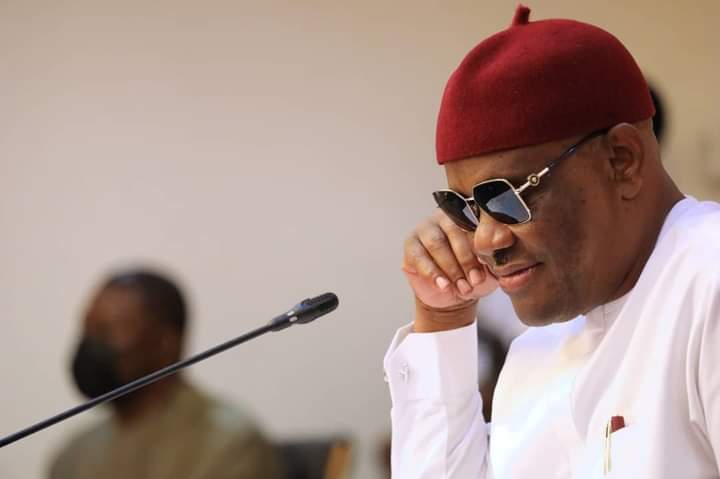
FCT Minister Ezenwo Nyesom Wike is a phenomenon. He is someone many love to hate. When the Secretary of the APC, Dr. Ajibola Bashiru, recently asked him not to import the brand of troublous and fragmenting politics of the PDP into the APC, he meant that Wike is the troubler of Nigerian politics. Wike’s anger is unexampled, his choleric outbursts phenomenal. He is a phenomenon in Nigerian politics, regardless. These have pushed me to undertake a psychoanalytical study of the Wike phenomenon. In doing this, my mind hovers over the negatively phenomenal child called Àjàntálá.
In the ancient Àjàntálá mythology, Yoruba reproduced a counterpoise of the western Frankenstein monster. As folklore and a cultural signifier, the Àjàntálá was a misbegotten child, a product of his father’s disobedience to the un-science of, though life-shaping, ancient epistemology and practices of his people. Àjàntálá’s hunter father had disobeyed widely held myth that when hunters’ wives were pregnant, they should cease hunting. The belief was that, if they shot a cantankerous game, it may, in anger, displace the foetus inside their wives and become a perilous child. This was the process that birthed Àjàntálá.
In the Amos Tutuola version of Àjàntálá’s story (Àjàntálá, The Noxious Child: 1986), the baby spent 23 years inside his mother’s womb. A few days before he was born, as his mother walked the bush path, the child began a conversation with her, even cavalierly suggesting its name at birth.
Àjàntálá became a burden to those who birthed him and his neighbourhood, the way Wike is a burden to the APC and the PDP today. Even those who did not purchase paid out of the bill. At his naming ceremony, the 8-day old child disrupted the proceedings, gluttonously consuming every food in sight and causing huge pains to his parents and all his naming ceremony attendees. As he grew, Àjàntálá manifested malevolent streaks, whipping his parents at intervals and beating to stupor a Babalawo, who was engaged to provide spiritual succour to his raving-mad Satanic theatrics.
The truth is, Nigerian politics is not for the lily-livered. It is only the Wikes, who understand it, who can survive it. Give it to him: Wike has colossal mastery of Nigerian politics. Nigerian politics is a weird life comparable only to life in the wild. It has face recognition with Thomas Hobbes’ famous phrase of a ‘nasty, brutish and short’ life. It is home to a vast array of wildlife. Monkeys, tigers, leopards, lions, reptiles of different hues inhabit the wild. So do they politics. These animals are consumed by a daily struggle to assert the jungle as their individual fiefdom. Indeed, the less said about politics’ sores, the better. Apart from its dense vegetation of plants, vines, and shrubs, the wild is a jungle.
The jungle, in the words of my people, is the forest of the heartless, (Igbó òdájú). In politics, brothers stab brothers and bloodlines are helpless to rescue. Joining Nigerian politics is like entering the uncharted space of the jungle. In it, there is an inversion of the norm. Betrayal is a virtue, honesty is a vice. Politics’ rules abhor rules, its order reeks of disorder and its beauty, manifest ugliness. Nigerian politics makes politics ashamed of its own virtues. It is where yellow is white, where worldly cunning is a virtue. In the wild, birds eat carrion of fellow birds. Boa constrictors swallow fellow snakes. Hyenas pierce their incredibly powerful incisors into the raw flesh of vulnerable lions of same cat family.
While urging those who cannot withstand the dog-eat-dog life in the jungle to flee its red-hot furnace, Yoruba Apala music legend, Ayinla Omowura, once warned that, “as we proceed into the jungle, the forest of the heartless, let mothers keep an eye on their children. Lions live in this jungle. Let lesser animals beware!” In another line, he admonished anyone whose mother was late and thus bereft of motherly spiritual tendering, not to proceed with him into the jungle because loud-sounding, frightening thunders herald entrances of initiates into the jungle. He could have meant Nigerian politics.
The wild is also not amenable to the logic of everyday life. To illustrate its unpredictability, my people capture it in a saying that if you wander far enough in the wild, not only will you come in contact with a hunchbacked squirrel (abuké òkéré), a snail with horns (ìgbín t’ó ní’wo) like that of an efòn (buffalo) or an àgbánréré, the rhinoceros, would walk past you.
Since 1922 when party politics began in Nigeria under the Clifford Constitution, with the introduction of the elective principle, we have witnessed hunchbacked squirrels, horned snails and even dogs that wore clothes in Nigerian politics. We have seen the sane, the insane and half-sane as politicians. In the early colonial time, the politician whose unusualness gained notorious mention was Herbert Macaulay. He had a complex mix of personal traits. Macaulay, nicknamed “the snake on the street” – “Ejòńgboro” was idealistic, flamboyant and stylish in his trademark bow-tie. Imbued with a very sharp intellect, he deployed this against the colonial government, prompting him to be given the moniker, “Wizard of Kirsten Hall”.
In the twilight of colonial rule, at the outset of self-governance, we had the lawyer and politician, Bode Thomas, son of a wealthy trader and auctioneer called Andrew Thomas. Haughty, self-conscious but brilliant, Thomas, one of the Alaafin of Oyo’s chiefs who held the title of Balogun of Oyo, picked strained relationships like a wastrel picks straying mango in the bush. Sir Ahmadu Bello and Alaafin Adeniran Adeyemi were some of the victims of his haughtiness. In a particular instance, Thomas had a spat with Alaafin Adeyemi at an Oyo Divisional Council meeting when he got irked that everyone else but the king stood up for him at his entrance.
Nigerian politics has produced a number of queer politicians and their absurd politics. One was Chief S. L. Akintola, the polyglot. S.L’s biting tongue was like a drop of acid that seared the skin. There was Mazi Mbonu Ojike of the “Boycott the Boycottables” fame. Ojike, an Nnamdi Azikiwe ally, also had a biting tongue like S.L’s. He was outspoken and a sophisticated critic with a cache of enmities in tow. He was once sued by Chief Obafemi Awolowo for libel. Ojike wrote two widely read columns in the West African Pilot newspaper which he entitled Weekend Catechism and Something to Think About. His Africanist belief was expressed in his preference for things African, for palm wine as against gin and African wares which he promoted among elites.. From Barkin Zuwo in the Second Republic, of the “government money in Government House” fame, to Busari Adelakun, Oyo State political behemoth and his famous, “no one can wear the cloth Ìpìn removes from its body.” Nigerian politics has had its fill of queer, non-conformist and atypical politicians.
Ezinwo Nyesom Wike is however in a class of his own. In Nigeria’s 26 years of the Fourth Republic, Wike stands out as an unexampled politician. Apart from Lamidi Ariyibi Adedibu, infamously known as the strong man of Ibadan politics, it is difficult to identify anyone else who possesses Wike’s atypical political credentials. Non-conformist and contumacious, Wike’s politics should engage doctoral dissertations. Hyper-smart, calculative and self-propelling, very seldom does any Nigerian politician have Wike’s kind of bursting political energy. Like Bode Thomas, Wike is audacious and does not have any qualm picking hot, hard-shelled political nut from a burning fire. To him, political life is a battlefield and captives must never be spared. To Wike, enemies and their allies must be captured and roasted, without a middle of the way. Wike is unlike many Nigerian politicians; he is unpretentious in his deadly, captive politics. He is obsessive with his crave for the klieg and has a natural people put-off in his imperious disposition.
Wike is also a hyper totalitarian who does not believe in a middle-of-the-way or half measure. In his political possession, Wike is pathologically jealous, sharing it seldom with anybody. It will seem to me that, apart from his audacity to attempt to upstage him, Wike’s main grouse against his political protege, Siminalayi Fubara, is that he is in a dalliance with his political enemies. His current battle with Fubara, much as it has a lot to do with teaching the governor a lesson, is also about political enemies he fought all his life to rout in Rivers, who now audaciously surround the pot of soup he unilaterally cooked.
In my piece, As Fubara presses the nuclear button, (December 17, 2023) I put the Rivers crisis to an Ikwerre-Ijaw supremacy tussle, among others. Fubara, an Ijaw, carries the grouse of his people against the polity. They allege marginalization in Rivers State politics, despite Ijaw’s significant population and massive contribution to the state’s economy. There is also the argument of Ijaw’s historical support for other ethnic groups in producing governors in the state since 1999. Other than Alfred Diete-Spiff, who was a military governor in the 1970s, not minding that they are spread over about eleven councils of the state, Fubara is the first civilian governor to have hailed from that riverine ethnic group. Ikwerre, on the reverse, who operate on the upland part of the state, occupy four local governments, and have produced Wike, Celestine Omeiha and Rotimi Amaechi.
In my December, 2023 piece, I cited an earlier character sketch of an Ijaw by Dr. Percy Amoury Talbot, as having a tangential relevance in the current political tiff in Rivers. Talbot, an early 20th century British historian and colonial administrator, apart from his colonial brief, was a British anthropologist and botanical collector. Born in 1877, he lived in the creeks for years to undertake his study and died in 1945. While in Nigeria, he was the Acting Resident of Benin Division in the 1920s. In his highly authoritative 1926 book, Peoples of Southern Nigeria: a Sketch of their History, Ethnology, and Languages, with an Abstract of the 1921 Census, Talbot reserved an unflattering description and frightening framing of the Ijaw. Hear him at page 333, “Up the various creeks and branches, the waters are infested by a wild piratical set who live almost entirely in their canoes, and who subsist by plundering traders while on their way to the markets, often adding murder to their other crimes.” Could this Ijaw ethnic profiling be responsible for what looks like Fubara’s disaggregating and piratical personality, what Wike last week referred to as his capacity to “retire me from politics if he gets a second term”?
Many other scholars who studied Fubara Ijaw’s very unique race couldn’t understand its abstruse origin and piratical ancestry. What remains apposite is that, Wike’s abstruse political brand is actually the DNA of most Nigerian politicians. What makes his own texture unique is his unpretentiousness. He wears his non-conformism on his face like a badge. Dr Lasisi Olagunju’s last week review of Bolaji Abdullahi’s about-to-be-released memoir, The Loyalist, has revealed that, outside of their harmless gentleman demeanour, many Nigerian politicians are deadly and power-besotting. Their converse in Wike in that, if he cannot stand you or your politics, Wike cannot pretend to be your friend.
Those who know Wike however say that he is one of Nigeria’s most meticulous politicians. Calculative, anticipatory and clinically-minded, the political Janus model Wike curated for himself, which makes him, simultaneously, a PDP stalwart and an APC political fixer, is a product of a meticulous study of Nigeria’s ambivalent and nil-rules politics. Though he is a lawyer, Wike capitalizes on the loopholes of law and the dirt in the temple of law to continuously put a leash on rules.
However, in the “holding down” of the PDP and perhaps other opposition political parties, alleged to be an assignment from the president, Wike may be unraveling as the “self-devouring snake” in Wole Soyinka’s mythography, Idanre. In it, Soyinka said this of the snake: “The creation snake/spawned tail in mouth” even as he also made the Ajantala allusion of rebirth in his mother’s womb.
The Wike alleged assignment from the president may end up as a tragic drama, both for himself and his political future. Though he is equally deadly and possesses the capacity to counter deadliness with deadliness, it is becoming obvious that the people Wike queued with today are deadlier than him. I remember how my mother used to admonish me whenever, as a boy, I impulsively dashed out to play with my friend, finding more joy outside than within.
In what can be interpreted as, “what a child knows how to eat best can be the death of the child” my mother said, “òde l’ó máa lé olóde wo’lé”. Wike may be nearing a point where both inside and outside would be too narrow for him to enter. The creative genius in Soyinka’s Idanre gives consummation to creativity, the Wike political creativity kind, but says this may also give rise to an unintended fatality. In the present case, the president, the alleged Wike assignor, may lead the FCT minister to his political calamity. As Soyinka puts it, “every creative act breeds and destroys (and) contains within itself both the salvation and the damnation.”
The plot would seem for Wike to be a sole faggot (igi wórókó) that disturbs a burning fire (tíí da iná rú) in the PDP. The more he denies it, the more his politics belies this. It may however end up being, for the assignor, who purportedly sent him on the assignment, the beginning of an end. Still for the assignor, Rivers is today the proverbial hen perched on a thin rope. For both the hen and the rope, there may be no peace.
As analysts, we have papered over Fubara needlessly. A psychoanalysis of the Rivers governor will show that he is also not a model which any politician should copy. He is serpentine, sly, deadly and has capacity for pyratical betrayal. If he could openly disdain his benefactor as he did Wike, the psychology of power says he should be an isolated specimen.
Yusuf Olatunji, venerated Yoruba Sakara music lord, once used the symbolism of rafters to explain possibilities of chaos, even in a glaring order. The rafters cannot cave in under the feeble and sleeky feet of a cat, “Àjà ò ní jìn m’ólógbò l’ésè,” he sang. However, seemingly contradictorily, Olatunji immediately sought the attention of the Àwòròsàsà (Yoruba scholars who possess wisdom to dissect issues and pick the most useful out of the lot). Pleadingly, the musician asked them to take up the gauntlet of ensuring order and amity so that the chaos of a rafter caving in under the soft tread of the cat does not happen. This speaks to the possibility of disorder in a perceived order.
Where are the Àwòròsàsà of Rivers State and Nigeria? The rafters are about to cave in under the feeble feet of the cat. Gone are the days when we externalized calamities. The time to save Rivers State is now.
